General-purpose I Os (GPIO)
GPIO introduction for stm32f4
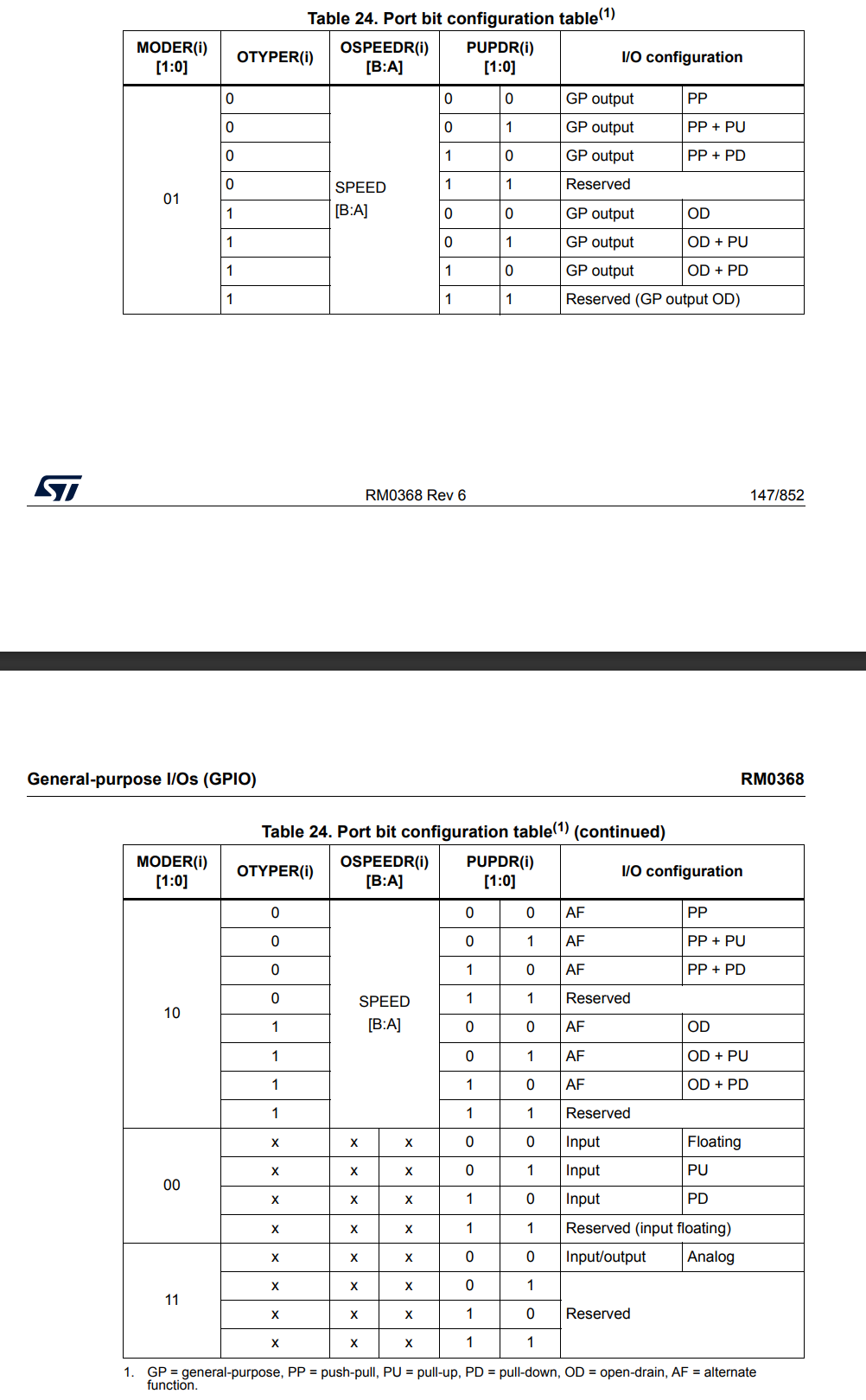
Each general-purpose I/O port has four 32-bit configuration registers (GPIOx_MODER,
GPIOx_OTYPER, GPIOx_OSPEEDR and GPIOx_PUPDR), two 32-bit data registers
(GPIOx_IDR and GPIOx_ODR), a 32-bit set/reset register (GPIOx_BSRR), a 32-bit locking
register (GPIOx_LCKR) and two 32-bit alternate function selection register (GPIOx_AFRH
and GPIOx_AFRL)
GPIO main features
• Up to 16 I/Os under control
• Output states: push-pull or open drain + pull-up/down
• Output data from output data register (GPIOx_ODR) or peripheral (alternate function
output)
• Speed selection for each I/O
• Input states: floating, pull-up/down, analog
• Input data to input data register (GPIOx_IDR) or peripheral (alternate function input)
• Bit set and reset register (GPIOx_BSRR) for bitwise write access to GPIOx_ODR
• Locking mechanism (GPIOx_LCKR) provided to freeze the I/O configuration
• Analog function
• Alternate function input/output selection registers (at most 16 AFs per I/O)
• Fast toggle capable of changing every two clock cycles
• Highly flexible pin multiplexing allows the use of I/O pins as GPIOs or as one of several
peripheral function